What Do We Vaccinate Against?
In the UK, there are four major killer diseases that we vaccinate against; these are the important infectious killer diseases:
- Overview
- Lifecycle of the Flea
- Diseases Associated with Flea Infestation
- Fleas and Man
- How to Tell if an Animal Has Fleas
- Drugs Used to Treat Fleas
- Environmental Flea Control
- Summary
- Flea Treatment of Rabbits
- General Flea Control Recommendations
- Integrated Flea Control Strategy
- Vetrica Flea Free Guarantee
Overview
Flea infestation is the commonest disease treated at Vetrica. Fleas are probably the most significant source of suffering for dogs and cats. All dogs and cats should be protected from flea infestation.
Dog or Cat Fleas?
Dog and cat fleas will happily live on both dogs and cats. In fact, the most common flea species found on dogs is the cat flea. The likelihood of finding a particular species of flea on a dog or cat is more likely due to geographical location rather than preference of the flea for dogs or cats. It is best not to think of fleas as either dog or cat fleas in this respect.
Lifecycle
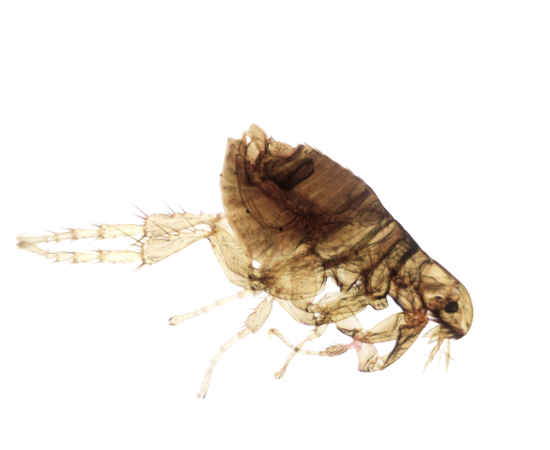
Adult fleas generally live on an animal, but can survive for a short time in the environment. When on an animal, they feed by sucking blood from the animal’s skin. They do this by inserting their long mouthparts into the skin, followed by the injection of saliva (this prevents the animal’s blood from clotting inside the flea’s mouthparts), and then sucking the blood. The injection of saliva is responsible for most of the symptoms of flea infestation.
Adult fleas mate on the animal, the female laying hundreds of eggs. These eggs (which are too small to see) are not sticky; they are smooth, allowing them to fall off the animal all over its environment. Anywhere an animal with fleas spends much time will have hundreds or possibly thousands of flea eggs.
Flea eggs hatch into flea larvae. Flea larvae look like microscopic caterpillars, and quickly wriggle away from the empty shell, trying to get away from the light. The larvae feed on environmental debris, but especially adult flea droppings. When fully mature, the larvae pupate, by spinning a cocoon. The cocoon is like a hard shell, and very effectively protects the larva as it develops into an adult flea.
Whilst in the pupa, which can be for a year or more, the larva is protected against most environmental insecticides. On hatching, the young flea jumps onto the first animal that passes. It quickly feeds, and starts to mate with other fleas, completing the lifecycle. The time from an egg being laid to an adult flea hatching from its pupa can be as little as 12 days under optimum conditions.
Diseases Associated with Flea Infestation
The most common problem is flea bite hypersensitivity. This occurs because of the way fleas feed. Flea saliva contains a variety of different proteins. When it is injected into an animal’s skin, these proteins are recognised as “foreign” by the animal’s immune system, which in turn leads to an immune response. The inflammation that results is what we would classically call a “flea bite,” and is intensely itchy.
Not every animal that is bitten by a flea reacts in the same way, and many (especially cats), are not bothered in any way. This is why some animals with heavy flea infestations have no symptoms at all.
Fleas are also important transmitters of various diseases. In the UK these are:
- Infectious anaemia (cats)
- Tapeworms (dogs and cats)
- Myxomatosis (rabbits)
Fleas and Man
Cat and dog fleas do not generally live on people. However, particularly in heavily infested environments, fleas will occasionally bite humans. Flea bites occur most commonly around the ankles and wrists. Bites result in raised, circular red spots that are extremely itchy. As time passes the central skin of the spot dies and flakes off, leaving a small hole. There is no requirement to treat people when their pets have fleas. Simply treating the animal (and the environment) is sufficient.
How to Tell if an Animal Has Fleas
The easiest way to tell if your pet has fleas is to look for flea droppings (faeces). These appear as black specks of dirt in the hair coat. If you see these on your pet, he has fleas. Adult fleas are less commonly found. In dark haired animals, it may be necessary to use a flea comb to find the droppings.
When placed onto a piece of wet cotton wool, flea droppings dissolve as a reddish-brown stain. Nothing else does this. The best areas to look for flea droppings are the rump, around the neck, and underneath the animal’s tummy.
Flea infestation can be extremely difficult to prove, especially in cats. Normal cats groom themselves every day, and when they do this, they remove adult fleas and their droppings. Some cats that are suffering from flea bite hypersensitivity will groom themselves so much that they remove all of their hair. Along with this they remove all of their fleas and droppings. Hair loss is a very common reason for bringing a cat to the vet, and in most cases, this is due to fleas.
Drugs Used to Treat Fleas
There are many drugs available in the UK to treat fleas. At Vetrica, we use what we believe to be the most effective, or easiest to use. There are two broad types of flea treatment: those that kill adult fleas; and flea contraceptives.
Drugs that Kill Adult Fleas
Frontline® (fipronil)
This is available as a spray or a spot-on, and is suitable for use in both dogs and cats...
Capstar® (nitenpyram)
Capstar is an oral insecticide. It is very fast acting – fleas start to die within 15 minutes...
Flea Contraceptives
Program® (lufenuron)
Program is available for cats as an injection or liquid suspension for mixing with the food...
What Not to Use
- Flea Shampoos
- Pet Shop Spot-On Products
- Flea Collars
- Flea Powder
Environmental Flea Control
95% of the flea burden of an animal is present in its environment...
Summary
- Fleas are a major cause of suffering in dogs and cats.
- Unless steps are taken to prevent it, most cats with access to outdoors will get fleas.
- Dog and cat fleas are essentially the same.
- Regular treatment with Program or Frontline will stop your dog or cat from ever having fleas.
- All dogs and cats in a household must be treated.
- Where a flea infestation is present, also use an environmental spray.
Flea Treatment of Rabbits
The rabbit flea is common in wild rabbits. During feeding, it transmits the virus that causes myxomatosis...
General Flea Control Recommendations
Fleas are much easier to prevent than eliminate, so the simplest way...
Integrated Flea Control Strategy
- Administer Capstar – This kills all the fleas on the animal now.
- Apply Frontline for 2-3 months – This kills the majority of newly hatching fleas.
- Treat the house with an environmental insecticide – Prevents further flea development in your house.
- Start Program to guarantee long-term freedom from fleas.
- Remember to treat all dogs and cats in the household.