Content
- What is Osteochondrosis?
- Which Joints are Affected?
- What are the Symptoms?
- Why Does Osteochondrosis Occur?
- Treatment
- Prevention
- Outlook for Affected Dogs
What is Osteochondrosis?
To understand what’s going on in osteochondrosis, you need to understand a bit about how bones grow. Bones grow by initially forming a cartilage template, onto which calcium is deposited to form bone (this process is called “ossification”, and when the cartilage has been turned into bone it is “ossified”). Osteochondrosis is an abnormality in this normal development of bones, and generally affects the joints. It resembles, but is distinct from hip dysplasia in many respects, in that it too is a developmental disorder of cartilage–bone formation.
The ends of a bone grow in two places. Firstly, at the epiphyseal plate. This is a cartilaginous region of the growing bone, the location of the greatest part of growth. Secondly, the cartilage which overlies the end of the bone, at the joint, also grows, and becomes ossified at the junction of bone and cartilage. You can see these areas of growth on this picture:
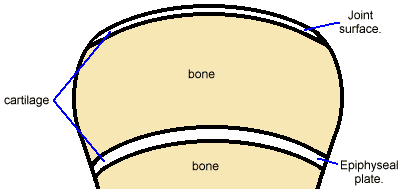
There are two main forms of osteochondrosis. If the problem occurs at the epiphyseal plate, then the overlying bone will not join properly to the main shaft of the bone. If the problem occurs at the joint surface, then a thickened area of cartilage develops which is only loosely attached to the underlying bone. This can shear, resulting in the formation of a flap. This is known as osteochondritis dissecans (OCD).
Which Joints are Affected?
Almost any joint in the body can be affected by osteochondrosis, but in dogs, significant problems are noted at:
Elbow
In the UK the most common form of osteochondrosis occurs in the elbow joint. There are three types of osteochondrosis of the elbow, which together form a syndrome which we call: “Elbow Dysplasia.”
- Fragmented medial coronoid process (seen in all large breeds, but especially Retrievers, Labradors, Rottweilers, Bernese Mountain Dogs).
- Ununited anconeal process (seen in GSD, Basset Hound, St. Bernard, and only rarely in other breeds).
- Osteochondritis dissecans of the medial humeral condyle (seen in the Labrador, Golden Retriever and occasionally the Rottweiler).
Of these, fragmented medial coronoid process is the most common. The locations of these problems are illustrated in the following pictures.
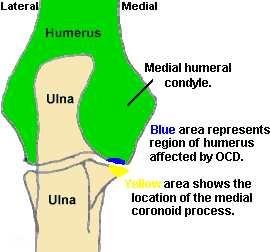
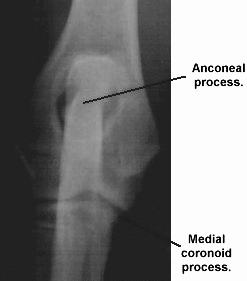
In the first of these pictures, we are looking forwards at the elbow joint from the back. You can see how the ulna (the long bone of the lower foreleg) overlies the humerus (the bone of the upper foreleg). The inside of the dog, which we call “medial,” is on the right, the outside, which we call “lateral,” is on the left. On the diagram, coloured yellow, you can see the coronoid process, which is a small bony prominence on the ulna. The anconeal process is not visible on this view, but its location is indicated on the x-ray picture. Looking at the x-ray picture, you can see that the medial coronoid process is, in fact, particularly difficult to see. This presents major difficulties in diagnosis (see also Treatment below).
Shown in blue is the area of the humerus which is affected by OCD.
When the medial coronoid process fails to develop properly, it crumbles into smaller pieces, hence the term “fragmented.”
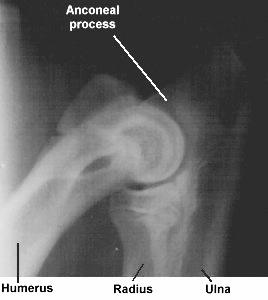
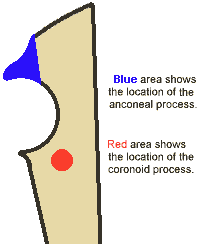
In this next set of pictures, on the left, you can see what the ulna looks like from the side, in isolation of other bones; on the right, an x-ray picture of the elbow joint fully flexed (bent), also viewed from the side. You can see the anconeal process, coloured blue in the diagram, forming a hook which latches into a notch in the humerus. The anconeal process is easy to see on an x-ray picture, and the diagnosis of ununited anconeal process is usually easy. If the development of the anconeal process is affected, rather than fragmenting, it becomes detached from the ulna. We call this “ununited.” The red area shows the location of the medial coronoid process.
Shoulder
There is only one type of shoulder osteochondrosis, and that is osteochondritis dissecans of the head of the humerus.
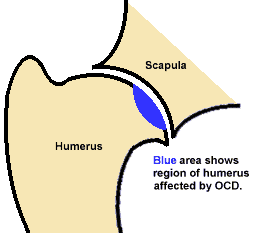
The shoulder joint consists of the scapula (shoulder blade) and the humerus, arranged as a ball-and-socket. The region of the humerus affected by OCD is always the same, and is shown on the diagram in blue.
Stifle and Hock
The stifle is only occasionally affected by OCD, especially in comparison with the elbow and shoulder. The hock joint is more commonly affected by OCD than the stifle, but less than the elbow and shoulder. The precise arrangement of the bones in the hock joint is very complex, and is beyond the scope of this article.
What are the Symptoms?
The symptoms depend on where exactly the dog develops osteochondrosis, but lameness and pain in the affected joint are consistent features. The dog may try and compensate for the lameness by restricting the movement of the affected joint. So, if the elbow is affected, the dog may swing his leg outwards in a circular motion to avoid bending the elbow. Although the condition usually affects both sides (e.g. left and right elbows), one leg is often worse than the other. As a result, the dog may take extra weight on the better leg, resulting in decreased muscle development in the worst affected leg.
Why Does Osteochondrosis Occur?
Like hip dysplasia, osteochondrosis is an inherited disease, with “environmental” influences. Taking these in turn:
Genetics. The concept of an inherited disease, where one individual acquires a disease from a similarly affected parent is familiar to most people. Osteochondrosis is an inherited disease. It’s not really quite that simple though, because not all dogs whose parents have osteochondrosis will actually get it themselves. Secondly, not all dogs with osteochondrosis are lame, and some seem to go for years before any problems become evident. Having said that though, genetics are very important in osteochondrosis, and the inheritance factor is even more important than in hip dysplasia.
Environment. Quite why some dogs don’t develop osteochondrosis, when they really ought to, based on their parentage, is not fully known. So we introduce another factor which we loosely call the dog’s “environment” to try and explain this. However, there are two significant things which do seem to play a part: diet and exercise, though there may also be other factors waiting to be discovered.
Diet. This is covered fully in the diet section of the puppy pages. Basically “over nutrition”, especially of calcium, phosphorus and calories is believed to play a part. Most people who buy a large breed puppy want it to be big. There’s nothing inherently wrong with that, but if you pursue this too vigorously, and overfeed the dog, or unbalance his mineral intake with supplements, then growth and development will not proceed correctly and osteochondrosis can result.
Exercise. The abnormality in osteochondrosis is the defective transformation of cartilage into bone. If a pup uses an affected joint too much, the defective cartilage can separate from the bone to which it is attached. This causes pain, instability of the joint, and starts the process of arthritis, which is an attempt by the joint to stabilise itself. By restricting the amount of exercise that the puppy has, you can limit the development of osteochondrosis (see also Prevention below, and the Exercise section of the puppy pages).
Treatment
There are two phases to the treatment of osteochondrosis:
- During the acute phase, when the dog is growing.
- During the chronic phase, when the dog has stopped growing.
Growing Dogs
There are two principal modes of treatment, irrespective of the joint involved in osteochondrosis: conservative treatment or surgery.
Conservative Treatment
Conservative treatment consists of three components:
- Pain relief
- Exercise restriction
- Dietary control
Pain relief. On the whole, pain relief is achieved using a family of drugs which we call NSAIDs (Non-Steroidal Anti-Inflammatory Drugs). There are a myriad of these, and are discussed more fully in the arthritis section.
Meloxicam (Metacam®). Meloxicam is a very effective pain killer…
Carprofen (Rimadyl®, Norocarp®). Carprofen is also a very effective pain killer…
Aspirin – Often causes vomiting and has a poorer safety profile than the above.
Ibuprofen (Nurofen®). Never give this to a dog.
Another drug to be considered here is pentosan polysulphate (Cartrophen Vet®; not to be confused with carprofen)…
Exercise control. All large and giant breed puppies should receive only regular short walks until they have finished growing… See also the Exercise section of the Puppy Pages.
Dietary control. Overfeeding contributes greatly to many orthopaedic conditions… See the Diet section of the puppy pages.
Surgery
There are a number of surgical techniques available for the treatment of osteochondrosis, depending on which type your dog has.
Osteochondritis dissecans. The loose flap of cartilage is removed under general anaesthesia…
Ununited anconeal process. The procedure here is to remove the loose piece of bone…
Fragmented medial coronoid process. This is the most frustrating variant to treat… Overall, the results of surgery are no better than conservative treatment, so conservative treatment is the best first option.
Adult Dogs
In many dogs, the original osteochondrosis problem has gone unnoticed… The outcome for practically all these cases is arthritis of the affected joint. The treatment of arthritis is covered fully in the Arthritis section.
Prevention
If we think about what causes osteochondrosis we can go on to form a rational plan to prevent its occurrence. This is primarily a hereditary disease with an environmental input, and it is at these two features that we can direct our efforts.
Genetics
The genetic component is very important in osteochondrosis…
The Elbow Dysplasia Scheme (BVA) grades elbows 0–3. Dogs should only be bred from with a score of 1 or less. Particularly important breeds:
- German Shepherd Dog (Alsatian)
- Great Dane
- Bernese Mountain Dog
- Irish Wolfhound
- Basset Hound
- Newfoundland
- Rottweiler
- Golden Retriever
- St. Bernard
- Labrador
- English Mastiff
If you are about to purchase a puppy of one of the above breeds, ask about both parents’ elbow scores before you buy. Do not buy the pup if either parent’s score was greater than 1.
Environment
Diet. See the feeding section of the puppy pages. Do not overfeed large and giant breed puppies. Feed only a good quality food balanced for growing dogs. Never give vitamin or mineral supplements.
Exercise. See the exercise section of the puppy pages. Give regular light exercise only to large and giant breed puppies.
Outlook for Affected Dogs
The outlook for dogs with osteochondrosis depends on which joint is affected. For OCD of the head of the humerus, medial condyle of the humerus, or stifle, it is invariably good with treatment; most dogs are completely free of pain and lameness after surgery. Dogs with an ununited anconeal process generally do very well also, especially if the dog is not required for very athletic work.
Fragmented medial coronoid process is different though. Only about 50% of individuals achieve full use of the affected limb. The remainder will require at least intermittent use of painkilling drugs, coupled with moderation of exercise and weight control. Some degree of arthritis is inevitable.